As humans spend increasing amounts of time indoors, we lose access to the sun’s natural benefits. Recognition of season affective disorder has grown accordingly. While the actual occurrence of the condition is low (around 5% — or 10 million or so Americans), it’s led to increasing awareness of the sun’s impact on the production of serotonin in the brain – and its resulting impact on the human body.
Light therapy lamps have become increasingly popular as a result. I bought one a while back. It’s big, unwieldy and beams bright light like a tanning lamp. These products rely on the visible light spectrum, in a bid to mimic the sun’s impact for those of us who spend more of our waking hours in front of a computer than we care to mention.
More recently, use of the “near-infrared” (NIR) segment of the light spectrum has been growing in popularity as a potential alternative to visible light. As the name implies, the segment sits between infrared and visible light, at around 600 and 1000 nanometers. According to the National Institute of Health, “low-level light therapy in the far-red (FR) to near-infrared (NIR) range of the spectrum, collectively termed photobiomodulation (PBM), has gained worldwide attention in recent years as a novel tool for experimental therapeutic applications in a variety of medical conditions.”
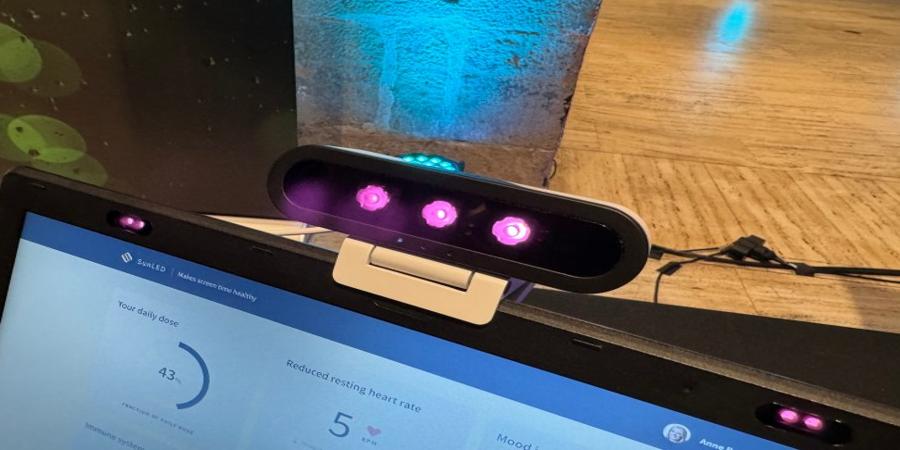
This weekend at MWC, a Dutch company (fittingly, given the lack of sunlight present during Netherlands winters) called Seaborough showcased small devices designed to replace large SAD lamps. One sits next to the computer and the other clips above display, looking a lot like an external webcam. Both plug into the USB port for power.
Unfortunately, the devices are proof of concept. The company told me it’s currently looking for partnerships to license the tech. I shot the lead image with an iPhone, which is able to capture NIR, which is why you see that purple-reddish glow. You can also see the glow coming from the surrounding bezels. Ideally ,Seaborough would eventually like to build it into the laptops themselves, though third party accessories seem far more likely. Heck, why not built it into an actual webcam?
As someone who’s battled a good bit of depression over the last few years, I’d certainly be willing to check it out. This stuff is really hard to review anecdotally, of course, as you need to factor in a potential placebo effect. I will say, however, that some research has been conducted on the matter. Take this, from a paper published a decade ago, “The results showed PBM treatment only at 6.5 J·cm−2 to have consistent positive benefits on well-being and health, specifically improving mood, reducing drowsiness, reducing IFN-γ, and resting heart rate.”
The research notes that the impact was only experienced in the winter months. It also didn’t have a meaningful impact on participants’ circadian rhythm. That said, it’s probably still safe to suggest that the jury is still out on a lot of this stuff.
Source @TechCrunch