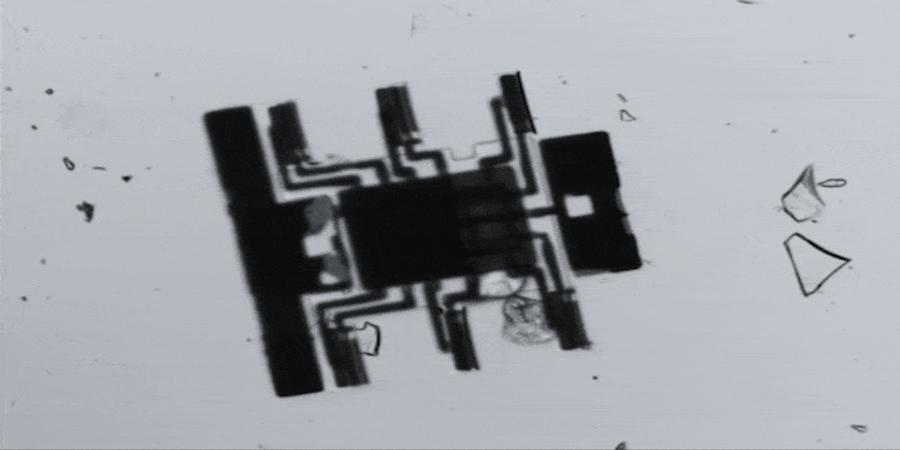
The competition to create ever smaller, ever better robots is a fierce one, and Cornell University is out front now with a set of bots small enough to sit on a human hair but that can move on their own using nothing but light as a power source.
Now, you may remember a similarly small machine from a few months ago, sitting proudly on the rim of a penny. Small, yes — but calling it a robot isn’t quite accurate. It was a tiny machine, for sure, but it operated through being repeatedly heated and cooled, leading it to expand and contract its legs.
The Antbots, as the lab led by Michael Reynolds calls them, are actually about the size of an ant to an ant — even smaller than the penny-perching crab one. And it also is much closer to what we would consider a robot, or at least a mobile electronic machine. Yet unlike almost any previous systems, there’s no wire necessary.
Antbots consist of three major systems: a photovoltaic cell to accept light as power, a tiny integrated circuit for controlling and directing that power and a set of hinged legs that it uses to scoot itself around.
To call this machine “autonomous” is a bit generous, but if you allow that they can operate without direct attention or input, such as a pulsed laser or radio signal coordinating their movements, it’s fair enough. It moves autonomously in that it needs only power but not with intelligence — it’s far too simple for that.
A few other designs were built to show how different gaits could be used, and a slightly larger and more capable “dogbot” was also made that can accept a single command — basically, a fast/slow switch. The intelligence of the robot is directly limited by the scale of the electronics — they just can’t fit enough on there to perform more complicated logic.
Image of an Antbot next to an ant and with its components marked. Image Credits: Reynolds et al. / Cornell University
Image of an Antbot next to an ant and with its components marked. Image Credits: Reynolds et al. / Cornell University
But the team used a rather large silicon fabrication process — 180 nanometers, when modern chips are created using sub-10-nm processes. By reducing the size of the circuits by an order of magnitude, they could either shrink the robot or multiply its intelligence by a similar amount.
Applications would range from environmental cleanup and monitoring to targeted delivery of drugs, monitoring or stimulation of cells, and microscopic surgery. In all these applications, robots with onboard control systems for sensing and responding to their environments and operating autonomously provide a notable advantage, setting the stage for ubiquitous smart microscopic robots with the capacity for positive outcomes in the world around us.
You can learn more about the project in the video below, or in the paper published today in the journal Science Robotics.
Source @TechCrunch