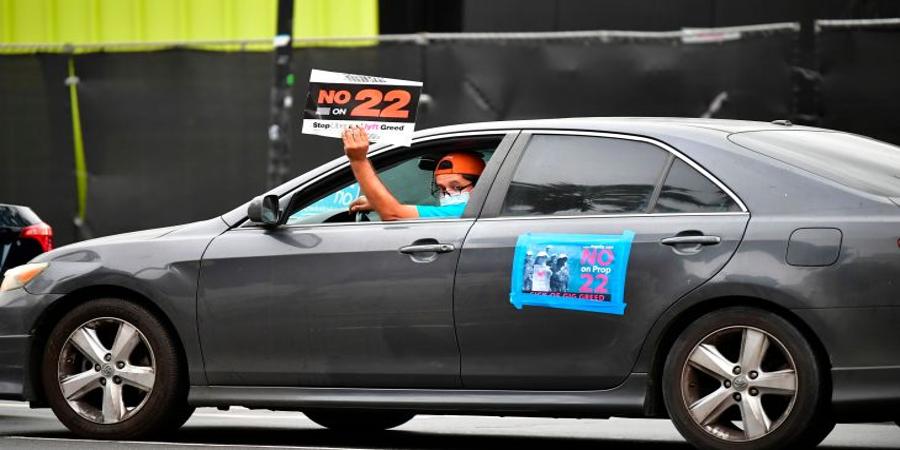
The fight over whether gig workers are independent contractors or employees has been heating up this week on both state and federal levels. The stakes? A once disruptive business model could soon be disrupted itself.
On the state level, this week has seen developments in the Proposition 22 saga as companies relying on gig workers put forth a slew of arguments against last year’s ruling that the law was unconstitutional and therefore unenforceable. Prop 22, a California ballot initiative, passed into law in 2020, allowing app-based ride-hail and delivery companies to continue classifying gig workers as independent contractors rather than employees. In August 2021, Alameda County Superior Court Judge Frank Roesch found the law conflicts with the state Constitution by restricting the legislature’s ability to regulate workers’ compensation rules.
In response to Roesch’s ruling, the very same coalition of major gig companies — like Uber, Lyft, DoorDash and Instacart — that spent millions on advertising to convince Californians to vote for Prop 22 filed an appeal to overturn the court ruling. On Tuesday, they called the challenge to Prop 22 an “attack on voters’ direct democracy powers” and out of line with California’s legacy of “guard[ing] voter initiative powers and uphold[ing] their acts wherever possible.”
The rehashing of this issue comes as the public comment period for the U.S. Department of Labor’s proposed independent contractor rule comes to a close. The rule, put forward in October, would tighten Trump-era laws on worker classification, making it easier for contractors to gain full employment status if they are “economically dependent” on a company.
The scope of the proposal is limited to areas like minimum wage enforcement, which has been a sticking point among labor activists fighting for gig worker protections. Prop 22 advocates say that the law ensures workers earn 120% of their local minimum wage. Critics say that app-based companies only count the time spent actively driving to pick up and drop off a customer or deliver a meal as “active time,” which leaves out the hours drivers spend driving to busier areas or simply waiting online for a gig.
One study found that by only counting active time, gig workers in Massachusetts could earn as little as $4.82 per hour if a similar law were passed in the state. (This subminimum wage has been backed up by gig workers TechCrunch has interviewed in the past.) In June, a Massachusetts court voted to throw out the ballot proposal.
Despite Judge Roesch’s ruling, because of the appeal, Prop 22 has remained in effect throughout the year. The appellate court is required to make its decision within 90 days, but attorneys involved in the case think it’ll happen much sooner.
On the federal level, those following the public comment period expect a ruling on the employment status of gig workers in the U.S. any day. It’s not yet clear how a passing of the DOL’s rule would affect Prop 22, if California’s appellate court allowed the ballot initiative to stick.
There’s a reason why companies relying on gig workers feel threatened by what could be a complete upheaval of their entire business models, so we can expect to see them continue to fight any changes through a variety of appeals and countersuits. In the background, some companies have made it a point not to rely on gig workers, perhaps sensing the way the legislative wind is blowing.
In New York City, Revel offers an all-Tesla, all-employee ride-hail service, which I’ve used and drivers have told me they love. Another on-demand ride-hail service that relies on employees is Alto, which operates in certain parts of Dallas, Houston, Los Angeles, Miami, San Francisco and Washington, D.C.
In Alto’s comment on the DOL’s ruling, the company pointed to the responsibility and costs it bears that its competitors shirk via the independent contractor model, like paying employees by the hour for all hours they spend driving, rather than only paying them for engaged time. Alto said that while this lowers competitors’ costs, it also encourages an oversupply of drivers on public roads leading to congestion and higher emissions.
“With independent contractor drivers, currently large-scale ride-hail operators intentionally over supply the market because it does not add to their costs and creates a ‘free’ (to the companies) consumer surplus through lower wait times,” reads the comment. “But, artificially lowering wait times with oversupply is unsustainable for drivers and leads to many making far less than minimum wage in the jurisdiction in which they work when measured on a total time (and not engaged time) basis.”
Alto called on the DOL to recognize the economic reality of the ride-hail industry — drivers are integral to ride-hailing as a business. Drivers’ work depends on the existence of ride-hail companies. Therefore, drivers are economically dependent on ride-hail companies, which puts them in the category of employees, according to Alto.
Source @TechCrunch