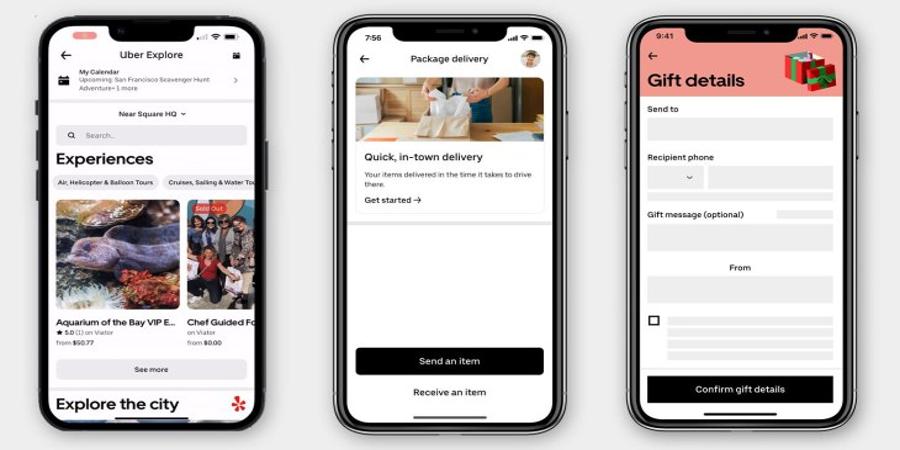
It’s been six months since Uber hosted Go, Get, a global smorgasbord of product reveals and features that covered everything from booking party buses and voice ordering for Uber Eats to linking travel plans to Gmail and skipping the food lines at sports stadiums.
The product reveals aren’t just about creating new revenue streams or attracting users — although these are certainly goals. Uber has a bigger end game: create a closed business loop with each product feeding customers back into other Uber channels. And that loop is growing.
On Monday, heartened by a strong momentum in user engagement and girded for the upcoming holiday season, Uber released another slew of product updates and new features. This time the products were released under the marketing banner of Go, get, give. Now Uber customers can do things like book with OpenTable and Viator through Uber’s app, search across merchants for the right bottle of booze to be delivered and even schedule Uber gift cards to send on Christmas day.
Uber was founded on a strategy of scaling at all costs. As Uber struggled to crack the elusive profitability nut through ride-hailing, it added its food delivery pillar Uber Eats. Now Uber appears to have taken a page out of the Amazon book of customer stickiness to attract new users and get existing customers to spend more money on the platform.
Just as Alexa, Amazon’s voice assistant, drives secondary revenue to Amazon every time a customer says, “Alexa, buy more shampoo and conditioner,” so, too, does Uber increase its ride revenue when a customer books an event via Uber’s partnership with Viator and then books an Uber to get them there.
Uber CEO Dara Khosrowshahi touched on this during the company’s third-quarter earnings call held November 1.
“We are actively cross-selling food delivery consumers into grocery, grocery consumers into alcohol, and actually back now to mobility,” said Khosrowshahi. “All of the cross-sell that we have across the platform continues to increase, drive new customers and drive retention, as well.”
There’s evidence to suggest that, at least in the short-term, there are fruits to these labors. In the third quarter, Uber’s gross bookings reached $29 billion, a 26% increase from the year prior. The company’s monthly active platform consumers (MAPC) grew 14% year-over-year from 109 million quarterly users to 124 million. If gross bookings grew at a rate faster than MAPC, we can infer that each customer is spending more on the platform than they would have.
“As far as the consumers go — high frequency, low frequency consumers — it’s absolutely true that if we can move our consumer use from lower frequency to higher frequency, we will see very significant growth,” said Khosrowshahi during Uber’s Q3 earnings call.
It’s not beyond the realm of possibility that Uber will extend beyond the mobility space and into other revenue channels. The company recently launched a new advertising division that oversees in-app ads during rides. To grow that business out, we might one day see Uber hiring creatives and using its vast amounts of data on riders to provide external marketing services for brands. Who knows?
While short-term reports show that Uber’s depth of products might have customer stickiness, the company should be wary of biting off more than it can chew. Uber made revenue gains in the third quarter, yet it still lost $1.2 billion, almost half of which can be attributed to operating losses. Tech giants and hotshot upstarts alike are in the midst of cutting costs — measures that include slashing jobs — as growth becomes more difficult amid the current economy. Even Amazon is not immune.
There are rumblings that Amazon is planning to lay off 10,000 people this week, and there is speculation that the company’s devices group, which includes Echo, Fire tablets and Kindles, could be on the list to get cuts. At an operating loss of $5 billion a year, it’s not hard to see why.
Source @TechCrunch