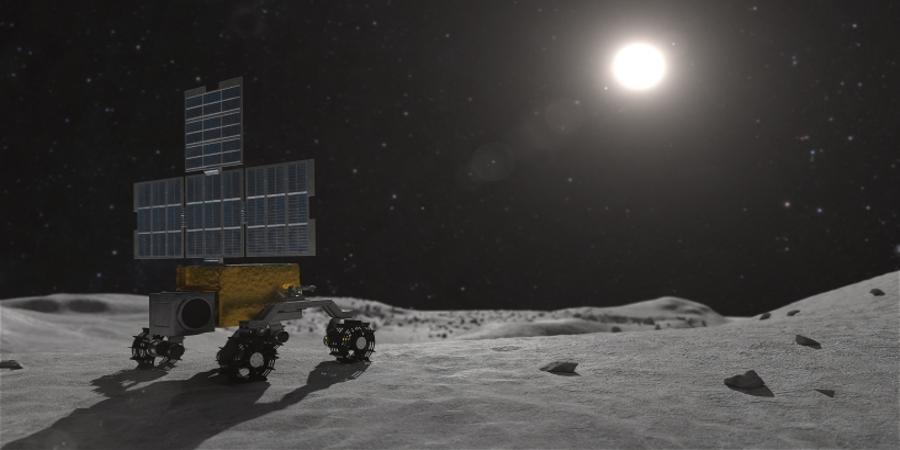
The portable power bank first came on the scene in 2001, and since then, on-the-go charging has been a possibility for most mobile device users. Now, a new space company wants to bring the concept of mobile charging to the moon — not for cell phones, of course, but for rovers and landers.
Toronto-based Stells, founded by CEO Alex Kapralov and CTO Vital Ioussoupov in 2021, is developing a rover called Mobile Power Rover (MPR-1) that would be able to provide power to lunar spacecraft via wireless charging. The company has secured a launch date in November 2024 via a SpaceX Falcon 9 rocket and an Intuitive Machines lander, with a tentative landing on the moon in January 2025.
Stells was initially interested in the lunar drilling industry, specifically in lunar craters. But early research proved that a power source for a drilling rover would likely be prohibitively expensive. That inspired MPR-1. “Why don’t we just provide power to others so they can have a redundancy in their power supply?” Kapralov tells TechCrunch.
Most spacecraft derive their power from one of two sources: solar panels and Radioisotope Thermoelectric Generators (RTG). Solar panels, of course, only function in areas that receive sunlight — deep craters don’t always receive any sunlight. Solar panels also require a lot of surface area. With rovers the size of cars, such as the ones on Mars, that’s not a problem. But the next generation of moon rovers will be much smaller. NASA, for instance, is developing Called Cooperative Autonomous Distributed Robotic Explorers that will be the size of shoe boxes.
RTG, on the other hand, is not reliant upon the sun, instead using the radioactive decay of plutonium-238 to create electrical power. The technology is, perhaps unsurprisingly, quite expensive, and it might not be cost-effective for small rovers.
Given the current push for moon projects — Artemis 1, for instance, launched with four CubeSats destined for the moon (along with six others heading elsewhere) — MPR-1 has the potential to be quite useful.
Illustration of a possible mining operation in dark crater, with power coming from solar at the edge. Image Credits: Stells
Illustration of a possible mining operation in dark crater, with power coming from solar at the edge. Image Credits: Stells
“The way we’re planning on delivering power is by using a box we call the wireless charging box, or WCB,” says Kapralov. The WCB would harness the power via solar panels — in the case of a lunar crater, it would place those on the crater’s rim, then run power lines down to the crater floor, where the WCB would be stationed.
The WCB would then store that power in its batteries, then distribute it quickly to other rovers via wireless charging. Those rovers, which would need a specific wireless charging port compatible with the WCB, would be able to navigate to the WCB using a beacon or visual navigation. With no atmosphere to attenuate the wireless power signal, this process would be much more efficient than on Earth.
Kapralov also hopes that the WCB would be able to travel to power-drained lunar spacecraft to provide a jumpstart charge, though that’s a challenge for a future mission. The first mission would simply be a technology demonstration for the WCB.
Thus far, Stells has been building prototypes and testing them on Earth — and it’s been entirely self-funded. “But we are probably going to start close to the beginning of next year to try to secure some funds for the development and the flight launch,” says Kapralov.
Over the past two decades, there’s been a significant push for lunar exploration, and while development is rife, results have been minimal. Google’s Lunar XPRIZE competition, for instance, had companies developing lunar rovers for a $20 million grand prize. The competition commenced in 2007 and had a 2014 deadline for a lunar landing; when it was clear no one would be ready by 2014, that deadline was extended, ultimately to 2018.
Though five teams secured launch contracts, Google ended the competition without a winner. Moon Express and Team Indus of those teams had their contracts canceled, while Hakuto/ispace and Synergy Moon are still working toward launch. The fifth team, SpaceIL, did launch to the moon in 2019, but its landing attempt failed.
Still, the lunar industry continues to develop, and more missions are closer to reality than ever before. Nothing is guaranteed — there is fertile ground for well-meaning failure. But the moon is the limit for the dozens of companies like Stells hoping to get there.
Source @TechCrunch