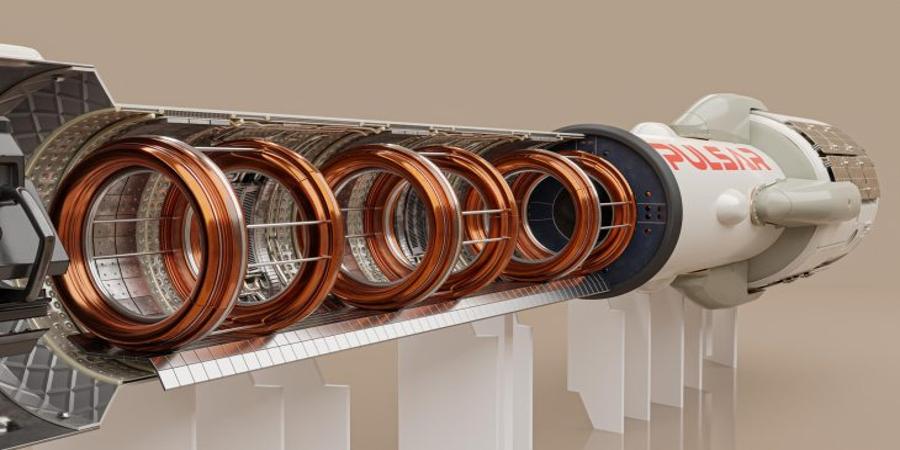
Space propulsion company Pulsar Fusion has started construction on a large nuclear fusion chamber in England, as it races to become the first firm to fire a nuclear fusion-powered propulsion system in space.
Nuclear fusion propulsion tech, arguably a golden goose of the space industry, could reduce the travel time to Mars by half and cut the travel time to Titan, Saturn’s moon, to two years instead of 10. It sounds like science fiction, but Pulsar CEO Richard Dinan told TechCrunch in a recent interview that fusion propulsion was “inevitable.”
“You’ve got to ask yourself, can humanity do fusion?” he said. “If we can’t, then all of this is irrelevant. If we can — and we can — then fusion propulsion is totally inevitable. It’s irresistible to the human evolution of space. This is happening, because the application is irresistible.”
For much of its 11-year history, the Oxfordshire, U.K.-based company mainly focused on fusion research. More recently, Pulsar started developing products that could bring in revenue while that research continues: a Hall-effect electric thruster for spacecraft and a second-stage hybrid rocket engine. The company was also awarded funding from the U.K. Space Agency in 2022 to develop a nuclear-fission based propulsion system, alongside the Nuclear Advanced Manufacturing Research Centre and Cambridge University.
But to Pulsar, the future of deep space travel lies firmly with fusion propulsion. Fusion for space propulsion is arguably much simpler than fusion for electricity generation here on Earth, in part because the conditions in space — very cold, and a near-perfect vacuum — are conducive to fusion reactions. The incredible energy density of those reactions would produce super-fast travel speeds, and require only a fraction of fuel compared to existing propulsive systems.
Even if such systems are very expensive, “speed in space is fungible with money,” Dinan said.
“If I can save you X many days in space, I can charge you for that,” he said.
One upside of this technology, even if it hasn’t yet been demonstrated in a system, is that the underlying physics is well-understood: fusion works similarly to our sun, by confining an ultra-hot plasma inside an electromagnetic field. The difficulty, for scientists, has been stabilizing that plasma for any meaningful amount of time. That’s Pulsar’s next task: building an eight-meter fusion chamber to bring plasma to ultra-hot temperatures and create exhaust speeds fast enough for interstellar travel.
“The difficulty is learning how to hold and confine the super-hot plasma within an electromagnetic field,” Pulsar CFO James Lambert explained in a statement. “The plasma behaves like a weather system in terms of being incredibly hard to predict using conventional techniques.”
The company has already started construction on that reaction chamber in Bletchley, England. It’s teamed up with New Jersey-based Princeton Satellite Systems to use supercomputer simulations to better understand how the plasma will behave under electromagnetic confinement. The pair will also model how plasma would behave exiting a rocket engine, and that data will help inform Pulsar’s rocket engine design. The next step would be an in-orbit demonstration, where the company would attempt to fire a nuclear-fusion powered propulsion system in space for the first time.
“If we’re going to leave our solar system within a human lifetime, there is no other technology that we know of that can do that,” Dinan said.
Source @TechCrunch