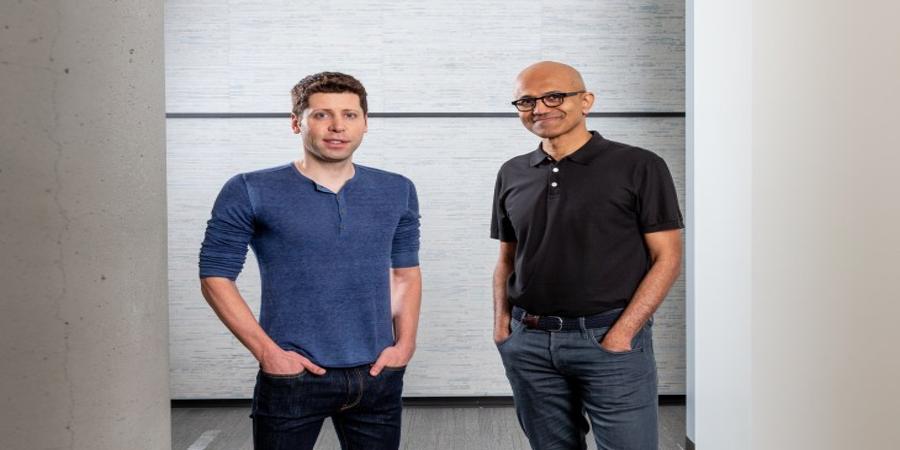
On Friday, the board of OpenAI, the AI startup behind ChatGPT and other viral AI-powered hits, did something unexpected but seemingly well within its right: removed the company’s CEO, Sam Altman.
But judging by how the situation’s unfolded, it seems that OpenAI’s investors and partners — and many of its employees — were more comfortable with the idea of the board’s power than it exercising that power. And they didn’t count on the cult of personality surrounding Altman, the former president of Y Combinator and a longtime fixture of the Silicon Valley startup scene.
On Saturday evening, just over 24 hours after the OpenAI board unceremoniously announced that Altman would be replaced by Mira Murati, OpenAI’s CTO, on a temporary basis, multiple publications published reports suggesting that the OpenAI board was in talks to have Altman return at the helm.
What changed their mind? The ire and panic, of investors, no doubt — and rankled ranks.
Satya Nadella, the CEO of Microsoft, a major OpenAI partner, was reportedly “furious” to learn of Altman’s departure “minutes” after it happened, and has been in touch with Altman — and pledged to support him — as OpenAI backers (in particular Tiger Global, Sequoia Capital and Thrive Capital) recruit Microsoft’s aid in exerting pressure on the board to reverse course. Meanwhile, some key venture capital backers of OpenAI are said to be contemplating a lawsuit against the board; none, including Khosla Ventures and LinkedIn co-founder Reid Hoffman, a former OpenAI board member, were given advance notice of the decision to fire Altman.
Khosla Ventures founder Vinod Khosla said the fund wants Altman back at OpenAI but will back him in “whatever he does next.”
@sama is a once in a generation CEO. He’s an instigator whose positive mark on the world will be indelible, and profound, in every corner of the globe. It’s an honor to work alongside him wherever he is.
— Vinod Khosla (@vkhosla) November 19, 2023
Microsoft in particular has a lot of leverage. OpenAI has received only a fraction of the company’s recent $10 billion investment, according to Semafor, and a significant portion of the funding is in the form of cloud compute purchases instead of cash. Withholding those credits — and the rest of the cash investment — could leave OpenAI, which is hungry for capital as the costs of running and training its AI systems mount, in a financially untenable position.
As the board considers its next move, OpenAI top AI researchers and executives are calling it quits.
On Friday, Greg Brockman, OpenAI’s president and a co-founder, resigned after the board stripped him of his position as chair. Three senior OpenAI researchers left after Brockman, including the director of research Jakub Pachocki and head of preparedness Aleksander Madry. And more employees are reportedly tendering their resignations.
They perceive it as a power struggle with unacceptable levels of collateral damage between two board members in particular, Quora CEO Adam D’Angelo and Sutskever, and Altman. Sutskever said during a company all-hands meeting on Friday that he felt removing Altman was “necessary” to protect OpenAI’s mission of “making AI beneficial to humanity,” suggesting Altman’s commercial ambitions for the company were beginning to unsettle the board’s kingmakers. (OpenAI’s board is technically a part of a nonprofit that governs OpenAI’s monetization strategy.)
But many in the tech community — and apparently OpenAI — felt the opposite. The outpouring of high-profile support for Altman was immediate.
And so, as Altman and Brockman approach investors about a new AI-chip-focused venture and OpenAI’s employee stock sale faces an uncertain future, the board of directors has an uncomfortable about-face ahead of it. Sutskever and the rest of the board — tech entrepreneur Tasha McCauley; and Helen Toner, the director of strategy at Georgetown University’s Center for Security and Emerging Technology — might’ve felt their decision on Altman’s firing was right and justified. But it seems it wasn’t truly their decision to make.
Case in point, The Verge reported late Saturday that the board had agreed in principle to resign — making room, perhaps, for a Microsoft-aligned member — and to allow Altman and Brockman to return. Altman is reportedly “ambivalent” about coming back and would want “significant” managerial changes, however, per The Verge’s sources; The Wall Street Journal reports that Altman told associates it was “ridiculous” that the major shareholders had no say in OpenAI’s governance.
The board’s since waffled, missing a deadline yesterday evening by which many OpenAI staffers were set to leave the company, reports The Verge. But its fate — and the fate of OpenAI’s structure — would appear to be all but sealed.
Source @TechCrunch