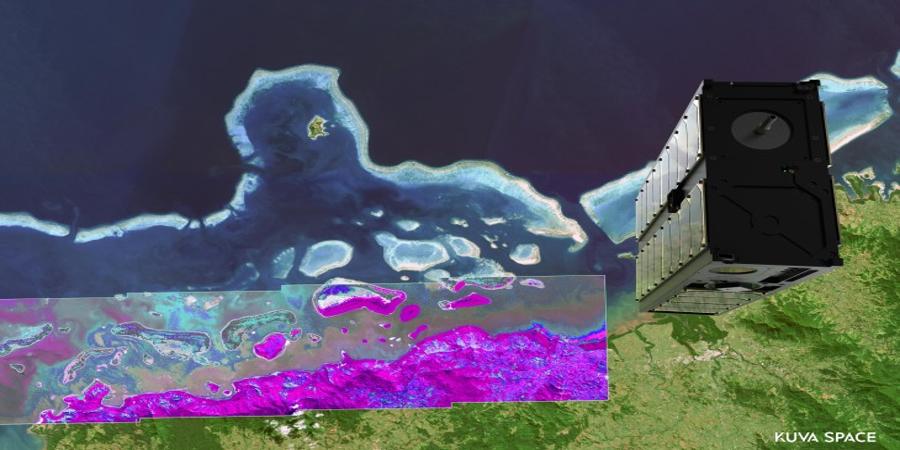
Kuva Space, a hyperspectral imagery startup founded in Finland, has closed a €16.6 million ($17.6 million) Series A funding round as it looks to deploy up to 100 satellites by the end of the decade.
The startup, formerly called Reaktor Space Lab, was founded in 2016 and spent its first four years focused on building nanosatellites for firms including the European Space Agency. It has successfully launched three satellites to-date, including a cubesat that contained a small hyperspectral camera demonstration. It was only around 2020 that the company decided to pursue a hyperspectral constellation, with Kuva closing a €4.2 million ($4.85 million) seed round in October 2021 to get started.
“Building nanosatellites for other people, it’s not the nicest business in the world,” Kuva Space CEO Jarkko Antila said in a recent interview. “We’ve been always looking at these different opportunities to go into digital services business, through maybe telecom or also hyperspectral.”
Hyperspectral imagery can read the “spectral signature” of materials on Earth, which means it can be used to identify crops, minerals, and even gas. There’s been demand for this type of information from verticals ranging from agriculture to oil and gas to defense.
Kuva says that its constellation’s ground pixel size will be the smallest amongst its competitors because it uses a 2D imaging system that layers together images from different bands using software. (It aims to launch two commercial microsatellites next year.) The company can also select which of the bands it wants its satellites to measure, a critical way to get better results for customers, Antila said.
“Instead of measuring 250 bands, you can have 25, and you can take 10 times more pictures from the exact same spot,” he explained. “With this you can increase the signal to noise ratio, which is the critical technical parameter in hyperspectral whether your data makes sense or not.”
Kuva plans to offer insights to customers via a subscription, with readily available data that does not require a customer tasking a satellite in advance. The startup’s aim is to reach a more than weekly revisit rate with a constellation of six satellites launched over the next two years. The company plans to scale to better than daily revisit for many parts of the world by 2026, and wants to scale to 100 satellites in orbit by 2030.
“We want to bring a true SaaS model to the Earth observation business,” he said.
The startup, which has bagged contracts with the European Commission and won the NATO Innovation Challenge, aims to establish a U.S. entity to open up opportunities to work with the U.S. Department of Defense and other American organizations. Some of those organizations, like the U.S. National Reconnaissance Office, have shown an appetite for such data. The company currently has 20 employees but plans on tripling its team in the coming months
The round was led by existing investors Voima Ventures and Nordic Foodtech VC, with participation from Singapore fund Earth VC. The round also included capital from Finnish private investors via a Finland growth fund called Springvest and non-equity funding from Business Finland.
Source @TechCrunch