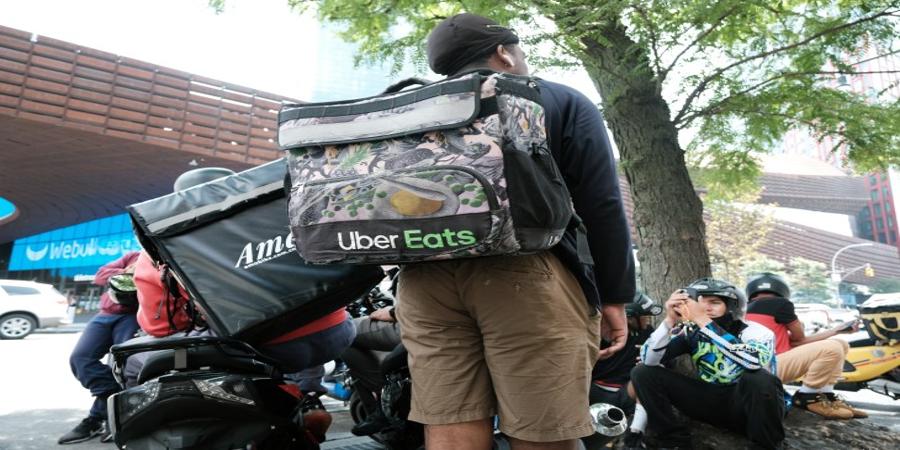
In a blow to Uber, DoorDash and Grubhub, a New York judge on Thursday ruled to allow the implementation of the minimum pay rate of $18 per hour for New York City’s food delivery workers.
The delivery apps sued the city in July, when the city’s 65,000 delivery workers would have begun seeing hourly payments, in an attempt to block the standard from being implemented. They were granted a temporary injunction at the time. Acting Supreme Court Justice Nicholas Moyne today ruled against the companies, making way for the minimum pay rate that will reach $19.96 per hour in 2024 to account for inflation.
“Multi-billion dollar companies cannot profit off the backs of immigrant workers while paying them pennies in New York City and get away with it,” Ligia Guallpa, the director of the New York-based Workers Justice Project, which helped lead the advocacy efforts for a minimum wage, said in a statement. “The judge’s ruling is another reminder that workers will always win.”
Delivery workers are considered to be independent contractors and therefore do not benefit from employee protections like minimum wage guarantee, workers’ compensation or paid sick leave.
The three delivery apps argued that a higher wage mandate would ultimately harm the end consumer, who would suffer from price hikes. They also argued it would hurt delivery workers by forcing companies to track time spent on the apps without making deliveries.
“The City continues to lie to workers and the public. This law will put thousands of New Yorkers out of work and force the remaining couriers to compete against each other to deliver orders faster,” said Josh Gold, an Uber spokesperson.
Relay, a smaller NYC-based delivery platform that operates as a courier service for restaurants, also sued the city and was granted an injunction.
Per NYC’s mandate, companies that use delivery workers will choose between one of two minimum pay rate options outlined by the city. The first option requires companies to pay a worker at least $17.96 per hour, excluding tips, for time spent connected to the app, which includes time spent waiting for a gig.
The other option involves apps paying $0.50 per minute of active time, exclusive of trips. Active time happens from the moment a worker accepts a delivery to the moment they drop off the food.
Uber, DoorDash and Grubhub haven’t specified which method of payment they might follow, but it’s possible they’d focus on the $0.50 per active minute option. Paying per active minute is already written into how these companies do business in many locations.
In California, where Proposition 22 is the law of the land, companies are guaranteed to pay at least 120% of the local minimum wage for active miles. If the minimum wage is $14 per hour, a delivery that took 15 minutes door-to-door would earn a worker $4.20.
Source @TechCrunch