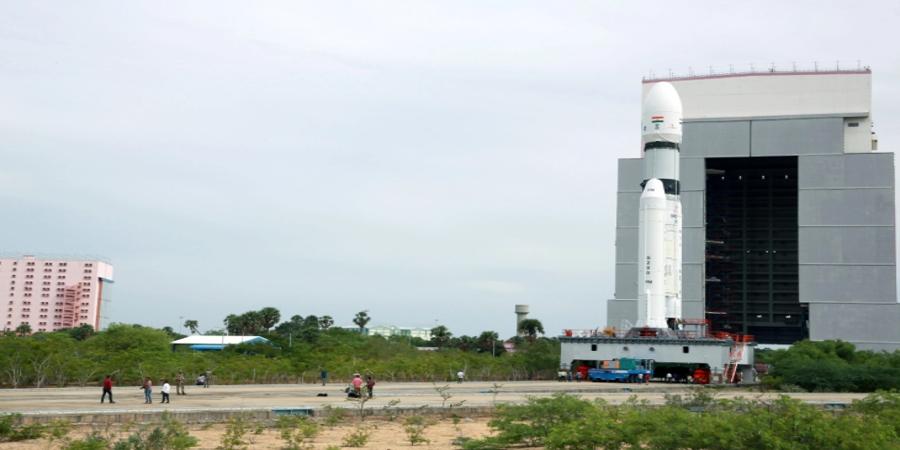
India will launch its latest moon lander mission Chandrayaan-3, a follow-on almost four years after the crash of its previous iteration in 2019, on July 14, the country’s space agency has announced.
The Indian Space Research Organization (ISRO) will launch the next Chandrayaan (Sanskrit for “moon vehicle”) mission using its Launch Vehicle Mark-III from Satish Dhawan Space Centre in South India’s Sriharikota island at 2:35 p.m. IST (2:05 a.m. PDT) on July 14, the space agency said in a tweet posted on Thursday. Codenamed LVM3 M4, the mission will comprise a lander, propulsion module and a rover — which aims to land safely and softly on the lunar surface, rove and conduct on-site scientific experiments.
The landing of Chandrayaan-3 will take place in August. If successful, India’s mission will make it the fourth country in the world to achieve a soft landing on the moon, following in the footsteps of the former Soviet Union, the U.S. and China.
First announced in January 2020, the Chandrayaan-3 mission was initially expected for 2022. The space agency has incorporated findings from its previous, $140-million moon lander mission, which failed minutes before a planned touchdown on the lunar surface in September 2019. It launched in July of that year, then traveled to the moon during the intervening months.
🚀LVM3-M4/Chandrayaan-3🛰️
Mission: The LVM3 M4 vehicle is moved to the launch pad.
The final stage of preparation for the launch commences. pic.twitter.com/fb5eg5nzrn
— ISRO (@isro) July 6, 2023
The lander in the mission will include technologies such as laser and RF-based altimeters, velocimeters, throttleable liquid engines, hazard detection and avoidance systems and a landing leg mechanism, the space agency said in a detailed note about the mission.
ISRO will also use a laser-induced breakdown spectroscope and an alpha particle X-ray spectrometer on the rover to do qualitative and quantitative elemental analysis, and examine the elemental composition of lunar soil and rocks around the landing site.
Over the past few years, India has made significant strides in advancing its space exploration efforts. The country also recently passed its space policy to ease collaboration between government bodies, including ISRO and space tech startups.
Alongside Chandrayaan, ISRO is working on the highly awaited human space flight mission Gaganyaan, which intends to take three people to a low-Earth orbit of about 250 miles for three days. The $1.8 billion project is expected in 2024. Last month, India also signed NASA’s Artemis Accords to collaborate with the program’s participating countries on space exploration.
Source @TechCrunch