It takes a lot of infrastructure, and money, to build the giant bioreactors experts say are needed to mass produce raw materials to make things like medicine, vaccines and cultivated meat.
Matt Anderson-Baron, co-founder and CEO of Canada-based Future Fields, told TechCrunch that 10 billion liters of bioreactor capacity will be needed by 2030, yet only 61 million liters of it exists today.
In addition, the recombinant protein, which is the output of the bioreactors, accounts for the majority of the costs associated with producing cultivated meat and is partly why that sector has not been able to reach price parity with traditional meat.
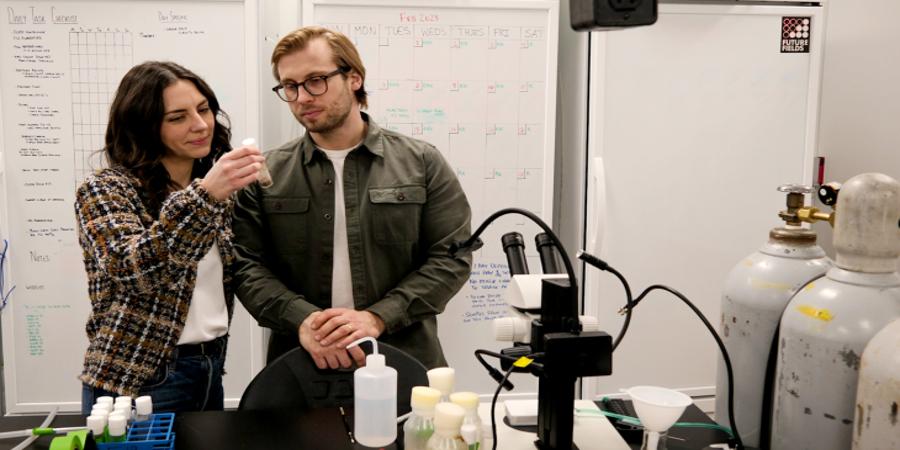
Future Fields thinks it has come up with a more cost-effective and sustainable way to do this through its EntoEngine, an approach that uses fruit flies — not giant steel tanks — for recombinant protein production.
“Traditionally, growth factors and recombinant proteins are produced in microbial systems grown in big stainless steel tanks, so they’re competing for the same infrastructure,” Anderson-Baron said. “Where we come in is we replace the bioreactor with an insect. We’re genetically engineering them — insects that can be grown in simple plastic containers — and it is very, very scalable, cost-effective and, importantly, circumvents the challenges associated with that infrastructure and frees that supply chain up for the people who actually need it or not, without creating more demand for it.”
Anderson-Baron, his wife, Jalene Anderson-Baron, and co-founder Lejjy Gafour have been working on this problem for a while (we last profiled Future Fields in 2020), and today announced $11.2 million in seed extension funding that enables the company to build a production facility to launch its first products outside of cultivated meat: research, cell therapies and biopharmaceuticals, as well as scale its team.
Joining Bee Partners in the round are Toyota Ventures, Builders VC, AgFunder, Amplify Capital, Milad Alucozai of BoxOne Ventures, Green Circle Foodtech, Siddhi Capital and Climate Capital.
Anderson-Baron declined to disclose growth metrics, but did say the company’s team has doubled in size over the last year, and it has shipped its animal protein product to more than 60 companies in the last year-and-a-half.
Future Fields is building its first production facility next to its corporate headquarters in Edmonton, Canada, and, once completed, will enable the production of recombinant proteins at kilogram scale with just 10,000 square feet of manufacturing space.
Meanwhile, its EntoEngine technology provides a suite of human recombinant protein products for medical research and biopharmaceuticals, including five proteins that aid in wound healing, reproductive biology, muscle and breast milk development and stem cell research.
Anderson-Baron said using the flies enables both speed and scalability. EntoEngine’s fruit fly technology can create biomass anywhere from 16 to 30 times faster than traditional bioreactors and is able to generate proteins every day with the same footprint and same infrastructure.
“That’s not possible with these other systems where you have designated bioreactors that are in operation often for weeks at a time to do one single manufacturing run,” he added. “It gives us a lot more flexibility, and importantly, we can scale up much quicker and more cost-effectively because we’re replacing the stainless steel tanks that need to be plugged into the wall with an insect.”
Got a news tip or inside information about a topic we covered? We’d love to hear from you. You can reach Christine Hall at chall.techcrunch@gmail.com or Signal at 832-862-1051. Or you can drop us a note at tips@techcrunch.com. If you prefer to remain anonymous, click here to contact us, which includes SecureDrop (instructions here) and various encrypted messaging apps.
Source @TechCrunch