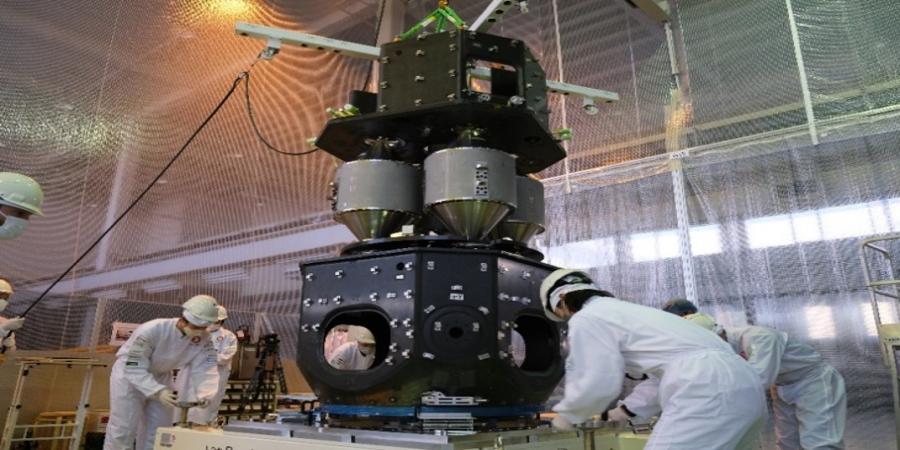
Tokyo-based ispace said Monday that its Hakuto-R lunar lander is on track to reach the moon at the end of April.
Ispace launched the lander on board a Falcon 9 in December; since then, the spacecraft has traveled around 1,376 million kilometers, the farthest a privately funded, commercial operating spacecraft has ever journeyed into deep space. The company anticipates completing all deep space orbital maneuvers by mid-March, followed by insertion into lunar orbit in late-March.
Ispace CEO Takeshi Hakamada said during a media briefing Monday that the flight has provided operational data that will inform subsequent missions. “We have acquired tons of data and know-how” on the lander and its subsystems, he said. “They are very viable assets for ispace.”
That includes information on the lander’s structural performance during launch and deployment, as well as the performance of thermal, communication and power subsystems.
“It’s almost impossible to assume everything perfectly before the mission,” Hakamada said. “It is inevitable to face off-nominal events.” Some off-nominal events in the mission so far include thermal temperatures hotter than the company anticipated and a brief, unexpected issues with communications after the lander deployed from the Falcon 9. The thermal issues have not affected operations.
The company has two more missions planned, aptly named Mission 2 and Mission 3, scheduled for 2024 and 2025, respectively. Mission 2 will be the next technical demonstration of the Hakuto-R lander system, and also a test of an ispace “micro rover” that will collect data on the lunar surface. Ispace’s eventual aim is to kickstart the lunar economy, largely through resource exploration and extraction; both the lander and rover will be important information-gathering sources as the company plans future missions.
The company will also be sending commercial payloads to the lunar surface for Mission 2, from companies including Takasago Thermal Engineering Co., Euglena Co. and the Department of Space Science and Engineering at Taiwan’s National Central University.
Ispace has different plans for Mission 3. That mission is being developed alongside aerospace contractor Draper, General Atomics Electromagnetic Systems and Systima Technologies, a division of Karman Space and Defense. Ispace is serving as the design agent and subcontractor for that mission. The companies won a $73 million contract from NASA as part of the agency’s Commercial Lunar Payload Services program to deliver scientific payloads to the moon. Ispace is also planning to send commercial payload customers alongside the scientific payloads. The companies currently negotiating final payload service agreements are AstronetX, ArkEdge Space, Aviv Labs and CesiumAstro.
Source @TechCrunch