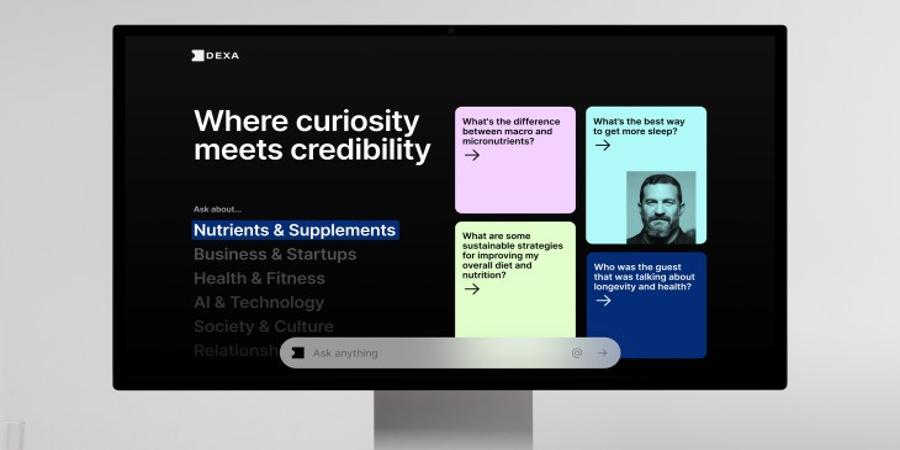
If you listen to a lot of podcasts, there is a chance you might remember funny tidbits and are wondering… “Wait, who talked about eating fries with sriracha again?” or more serious questions. To look for the answers, you have to first find the podcast and then search through their transcripts. Dexa is trying to make podcast search easier by leveraging AI.
The tool lets you ask questions about a single podcast, like Andrew Humberman’s Huberman Lab podcast in the screenshot below, or query all the podcasts in Dexa’s database — there are currently more than 120 with more being added. The search results will give you an AI-generated summary of the answer along with pointers to podcasts where the participant discussed the topic.
For instance, you can ask questions like “What’s the best way to get more sleep?” and find answers to that from Dexa’s podcast library with timestamped links to those conversations. You can also @mention a specific podcast to narrow down your search results.
When I asked Dexa “What does Mark Zuckerberg think about Threads?” it returned the results of his conversation on Lex Friedman’s show about the social network. But it also showed me results where podcast hosts were talking about Mark Zuckerberg’s comment about Threads on another platform.
You can also share these searches and results with others through links. Because of this, Dexa is able to also index some of the content for search engines like Google.
Dexa was started by Riley Tomasek in 2023, who previously co-founded an app called Flight for users to capture notes, images, and ideas on different boards and collaborate across them. The company was acquired by Figma in 2021.
Tomasek said that he really got into health. As part of his knowledge building phase, he listened to the Huberman Labs podcast. He wanted to take a supplement Huberman suggested but forgot the dosage. So he started searching back for when the neuroscientist talked about it and the process took a long time.
“After this experience, I decided I’m going to build something to make this easier because I don’t want to go through this process again. So I transcribed all the episodes and used tools like OpenAI’s embeddings and Whisper to make the search work and posted it on X,” Tomasek said.
After Tomasek posted about his tools Huberman retweeted it and that generated inbound interest from podcasters and listeners for the tools’ development. He said that a lot of podcasters talked about people not being able to find specific content.
The startup uses different indexing techniques mixed with a knowledge graph of people, episodes, and shows to power its search. Tomasek said the tool launched nearly nine months ago, and has answered over 1 million queries with 50,000 people visiting the site each month.
Dexa has raised $6 million in seed funding led by Abstract Ventures and The General Partnership with participation from Maple VC and Guillermo Rauch. The company currently has three people on the team and it now plans to hire more engineering staff.
The company is launching a redesigned site and announcing a partnership with Huberman Labs where Dexa’s search will be embedded on the podcast’s site. For that, the startup has trained a special model — think of it as a GPT in ChatGPT.
The new design lets users ask follow-up questions and lets them watch the linked conversation without having to leave the window.
Dexa’s growth has mostly been organic with podcasters referring people towards the tool. He said that this method still has momentum as the company works with popular podcasters. So it is not looking to invest in outreach at the moment.
“We briefly tried advertising on podcasts, and found out that our attempts ended in a relationship where we indexed their content, added it to Dexa, and they started to organically talk about it,” he said.
The company is not currently making any money, but it has considered both subscriptions and ads as sources of revenue as it scales.
Dexa also plans to build a mobile app, where it can drive more consumption to podcasts through short clips. Additionally, the company is planning to introduce account creation so people can save their searches.
There are plenty of tools including Riverside, Podcastle, and MusixMatch that help podcasters with transcription. In terms of search, the newly pivoted Very Disco is trying to become a sort of IMDB of podcasts with information like books, people, and TV shows mentioned in podcasts.
MusixMatch’s chief product officer Marco Paglia sees the promise in what he calls the “assistant-driven UX” of Dexa. Plus, he feels that there is potential in allowing people to retrieve a specific person’s opinions through podcasts. But his reason for not embedding such a search in MusixMatch is that he feels text is not the best way to interact with LLMs.
“I feel that typing on a chat is not the best UX for assistants. Instead, for this use case I strongly believe that voice is the future,” he said.
Ben Cmejla, partner at The General Partnership, believes that Dexa’s approach of using knowledge from creators for search is unique.
“A platform’s success or failure will hinge on the trust it builds with users and content partners. Dexa’s approach puts trust first — user trust that answers to their questions come from human experts, and partner trust that their content will be showcased, not just used for training data or anonymized summaries,” he said.
Source @TechCrunch