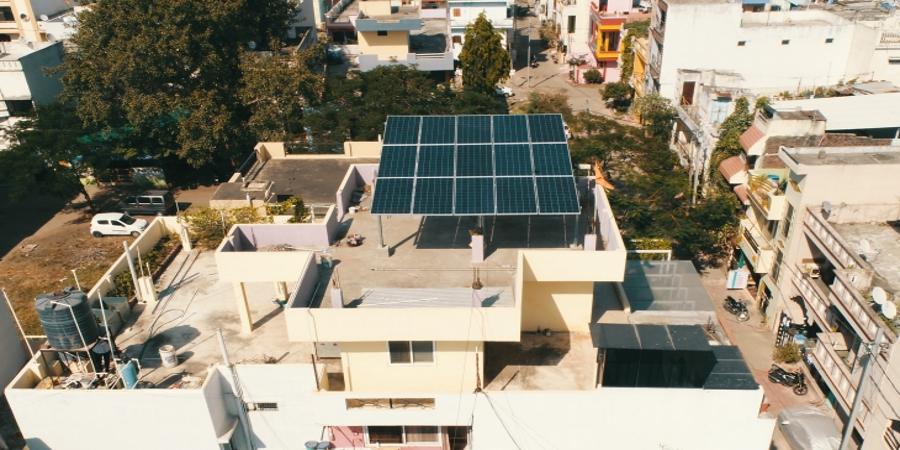
Chris Sacca’s Lowercarbon is doubling down on a startup that is racing to bring solar modules to rooftops in India.
SolarSquare said on Thursday it has raised $13 million in a Series A funding round led by Lowercarbon and Elevation Capital, just months after securing its seed financing. Existing backers Good Capital, Rainmatter, Better Capital and social commerce Meesho founders Vidit Aatrey and Sanjeev Barnwal also participated in the round.
Even as India is increasingly adding generation capacity from solar power, there’s a large population of the South Asian nation – the individuals – that is yet to join the clean energy bandwagon.
Less than 0.5% of Indian homes have rooftop solar systems. Such slow adoption could dampen Prime Minister Narendra Modi’s ambitious renewables goal. SolarSquare, which sells, installs and helps individuals finance solar modules, has an ambitious plan to change that. The startup also provides its solar solutions to housing societies and commercial establishments.
SolarSquare says it has solarized close to 5,000 homes in India in the last two years, helping them save about $480 yearly on their electricity bills and offset four metric tons of carbon dioxide emissions.
SolarSquare, which pivoted to serving the customer segment two years ago after running a profitable business selling rooftop solar to corporates for years, is currently generating revenue at a runrate of $12 million a year, said Shreya Mishra, co-founder and chief executive of SolarSquare, in an interview with TechCrunch.
“We are on a path of being a full-stack rooftop solutions provider. The market opportunity is so large, you can imagine the trust a middle class homeowner has to have to make a purchase of that size. We are innovating on every aspect of solar installation to serve our customers,” she said, adding that she estimates that solar modules worth more than $50 billion will be purchased by residences in India in this decade.
The average ticket size of a purchase of the solar module is about 2 lakh Indian rupees, or $2,410. SolarSquare also helps customers with financing options through a network of partners. Mishra said she sees the startup get a license to operate its own nonbanking financial institution to provide better options to its customers in a year.
Nikhil Nahar (left) and wife-husband duo Shreya Mishra and Neeraj Jain founded SolarSquare. (Image credits: SolarSquare)
Nikhil Nahar (left) and wife-husband duo Shreya Mishra and Neeraj Jain founded SolarSquare. (Image credits: SolarSquare)
“Solar as a product purchase pays for itself. It’s unlike a product like, say, your refrigerator, which is an expense. Once you have put solar modules on your rooftop, you start saving each month. A 2 lakh investment will result in savings of 12 lakh to 14 lakh in 25 years. But there’s a high upfront investment, so once we realized that, it’s clear that we need to bring more financing options to customers,” she said.
SolarSquare — which currently has presence in Bengaluru, Delhi, Gujarat, Hyderabad, Madhya Pradesh and Maharashtra— installs its solar panels within hours, compared to some legacy firms that take up to five days. In some homes, based on customers’ request, it builds elevated structures for mounting panels. The startup plans to expand across India with the fresh funding.
“Solar is now much cheaper and cleaner than digging up and burning old dinosaur bones, so putting it on your roof just makes sense, especially in a part of the world with as much sun as India,” said Sacca in a statement. “But getting panels installed wasn’t always easy. We backed Shreya, Neeraj, and Nikhil because they’ve cracked the code on hassle-free rooftop solar.”
Indian firms making inroads with Indian residences will help the South Asian nation’s renewables goal. Coal currently powers 70% of India’s electricity generation, but Modi has pledged that India will produce more energy through solar and other renewables than its entire grid now by 2030.
It has taken steps to help startups such as SolarSquare. New Delhi offers subsidies to homeowners who are powered by rooftop solar, allowing them to distribute the excess power they generate to grids throughout the day and use the grid power at night.
Mishra praised New Delhi’s efforts on climate change, saying: “India is the first country in the world to make net-metering, this exchange of electricity, a consumer right that makes economics more viable as you’re able to freely trade electricity with the grid. More than 80% of our homes meet 100% of their electricity requirements this way.”
“Net-metering is a policy in many parts of the world. In India, it’s a right. A policy is something that can be revised every few years, but a right is a right that is going to stick. This is one of the reasons why we became so bullish on serving the residential solar market in India. As long as net-metering is a consumer right, there is nothing else that is needed.”
Source @TechCrunch