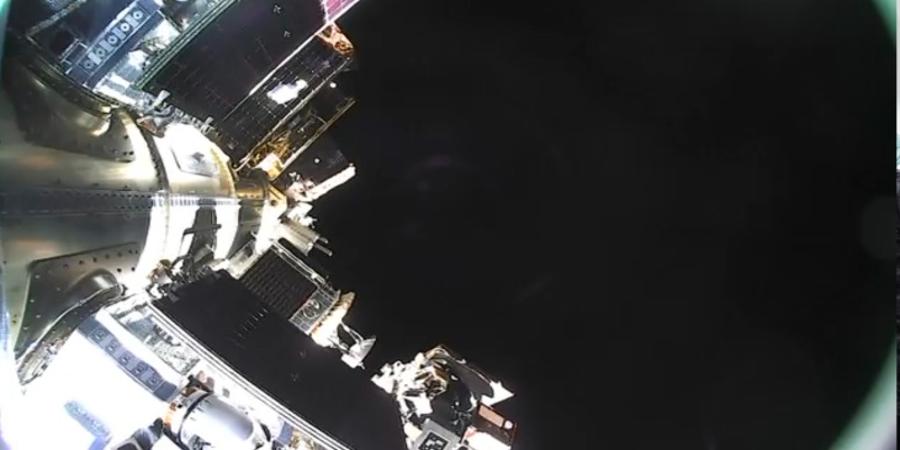
Launcher’s Orbiter spacecraft experienced an anomaly after reaching orbit that will likely result in the premature end of its customers’ missions, including Starfish Space’s Otter Pup demonstration mission.
Launcher and its customer Starfish Space released a joint statement Wednesday detailing what happened in the hours after the Orbiter spacecraft lifted off on SpaceX’s Transporter-8 mission earlier this month. While the spacecraft successfully separated from the launch vehicle, it experienced a software-related issue that induced a high rate of rotation. This issue, in addition to critically low fuel and battery levels, forced Launcher to make the “emergency decision” to deploy customer payloads earlier than anticipated.
As a result of the early deployment, Starfish’s Otter Pup demo satellite also started experiencing high rotation. While Starfish confirmed that its satellite is alive, the mission — in which Otter Pup was going to attempt to rendezvous and dock with Orbiter — will not be able to continue until the satellite is stabilized in orbit.
“Given the events experienced post-launch and the current state of the satellite, it is unlikely that Otter Pup will be able to continue with its mission,” Starfish said in a statement. “However, we will continue to try to save Otter Pup, and we are grateful for the continued support of our partners.”
Starfish co-founder Austin Link told TechCrunch that, as a first step, the company will attempt to reduce the spacecraft’s spin rate using on-board torque rods — essentially electromagnets that push off Earth’s magnetic field to affect attitude control and tumbling. From there, the company will need to run a series of check-outs to ensure that all the vehicle’s components are still working properly.
“Are things still working on the spacecraft or are they just broken at this point, because we’re really well outside of the bounds of what various pieces of hardware are designed or expected to see on orbit,” he said.
He added that the Otter Pup is currently spinning at a rate of one full rotation per second, while spacecraft are generally designed to handle a spin rate of just one or two degrees per second.
“We’re a couple orders of magnitude outside of the normal operation bounds,” he said.
For its part, Launcher says it eventually lost contact with Orbiter due to “non-optimal solar array pointing,” but that it will continue to try to re-establish contact in case the spacecraft is able to charge its batteries again. Launcher said that it had already identified the likely root cause.
In addition to Starfish Space’s Otter Pup demo satellite, Orbiter was also carrying several other customer payloads, including cubesats from Innova Space and TRL11, a space startup developing video for in-space applications.
Although Launcher’s Orbiter mission was named SN3, it is actually only the second time the Orbiter Launcher has actually launched. The first mission, called SN1, took place at the beginning of January and also ended in failure due to an issue with the spacecraft’s power systems. Launcher is planning on sending up its third Orbiter mission in February 2024, followed by two more flights that year.
Launcher was acquired by Vast, a space station company founded by Jed McCaleb, in February of this year for an undisclosed amount.
TechCrunch has reached out to Launcher for additional comment and will update the story if they respond.
The story has been updated to include Starfish’s comments and to reflect that torque rods push off the Earth’s magnetic field.
Source @TechCrunch