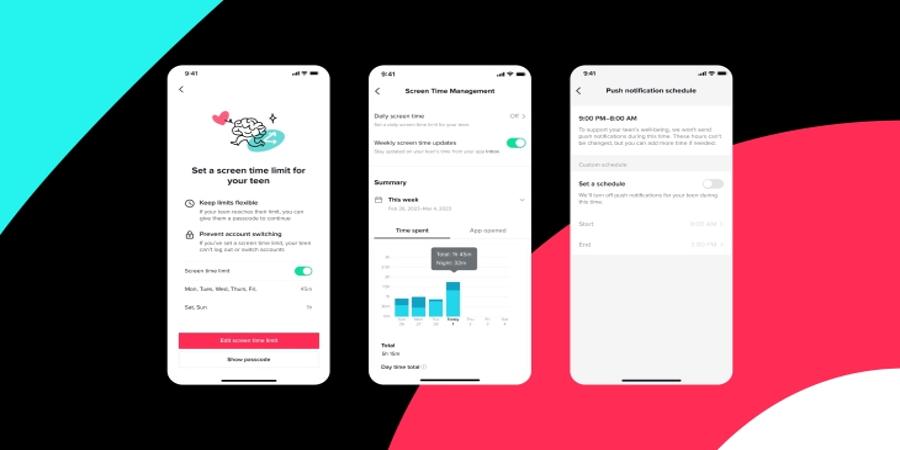
TikTok announced today that it’s introducing new well-being features for teens, families and its broader community. The company is improving its screen time controls with more custom options, introducing new default settings for teen accounts and expanding Family Pairing with more parental controls.
Every account belonging to a user under the age of 18 will soon automatically be set to a 60-minute daily screen time limit. Once the 60-minute limit is reached, teens will be asked to enter a passcode in order to keep scrolling. For users of TikTok’s under 13 experience, the daily screen time limit will also be set to 60 minutes. If the screen time limit is reached, a parent or guardian will need to set or enter an existing passcode to enable 30 more minutes of watch time.
The app will prompt teens to set a daily screen time limit if they turn off the 60-minute default and spend more than 100 minutes on TikTok in a day. In the company’s first month of testing, it found that this approach increased the use of its screen time management tools by 234%. TikTok will also send every teen account a weekly inbox notification with a recap of their screen time.
TikTok is also adding new features to its Family Pairing tool, which lets parents link their account to their teen’s to enable content and privacy settings. Most notably, the company said it’s in the early stages of developing a way for caregivers to filter videos with words or hashtags they don’t want their teen to watch. TikTok is in the process of working with parenting, youth and civil society organizations to design this feature.
In addition, Caregivers are now able to use Family Pairing to customize the daily screen time limit for their teen, including the option to select different time limits depending on the day of the week. For instance, you can allow your teen to have more screen time during the weekends and holidays, while restricting screen time during weekdays.
The company is also bringing its screen time dashboard to Family Pairing. The dashboard includes information about how much time a teen spent on the app during the day and night, along with stats about how many times they opened the app. TikTok says that by proving this information to caregivers directly, they will be able to guide their teens.
TikTok is also introducing a new setting that enables parents to set a schedule to mute notifications for their teen. It’s worth noting that accounts of users aged 13-15 already don’t receive push notifications from 9pm and accounts of users aged 16-17 have push notifications disabled from 10pm. TikTok says it’s aware that although notifications help people stay connected, there are times when it’s important to be uninterrupted.
As for its broader community, TikTok says it wants all of its users to feel in control of their experience on the app, which is why it’s giving everyone the ability to set their own customized screen time limits for each day of the week and set a schedule to mute notifications. The company is also rolling out a sleep reminder for users to remind themselves when it’s time to put the app down and go to sleep.
“We’ll continue to invest in improving our current features as well as introducing new tools to help people stay in control as they express their creativity, make meaningful connections, and enjoy culture-defining entertainment,” the company said in a blog post.
A recent report revealed that TikTok is the social app kids and teens are spending the most time using throughout the day, even outpacing YouTube. Given its popularity among kids and teens, it’s no surprise that TikTok is looking to enhance its well-being features for young users.
Over the past few years, TikTok has faced scrutiny regarding the app’s impact on its youngest users. It’s been more than a year after executives from social media platforms, including TikTok, faced questions from lawmakers during congressional hearings over how their platforms can negatively impact young users. Since then, the company has released updates focused on minor safety. The new features announced today are part of the app’s efforts to appease lawmakers.
Source @TechCrunch