Astroscale, a company that’s developing technology to service satellites and clean up orbital debris, has closed another round of funding and widened its investor pool to include a space enthusiast billionaire and a major Japanese manufacturing multinational.
The Series G round comes in at more than $76 million, bringing the company’s total funding to date to $376 million. The new investors include Yusaku Maezawa, the billionaire behind the private spaceflight project “dearMoon” and the first private Japanese citizen to visit the International Space Station, as well as Mitsubishi Electric, Mitsubishi UFJ Bank, Mitsubishi Corporation, Development Bank of Japan and FEL Corporation.
Separately, Astroscale also announced a new partnership with Mitsubishi Electric to jointly develop and manufacture satellite buses for Japanese national security constellations. The buses will be outfitted with an Astroscale docking plate so that the buses can be docked with and moved in the event that they are unable to de-orbit themselves at the end of their useful service life.
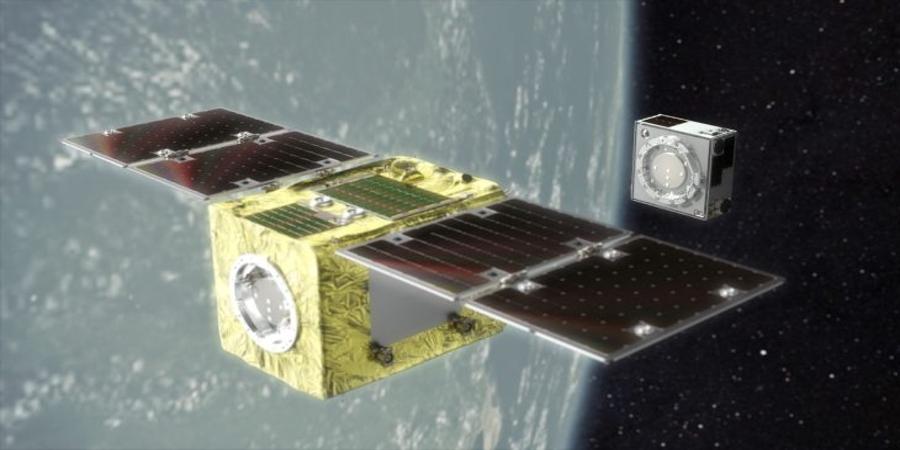
Astroscale is developing a range of technologies under the umbrella of “in-orbit servicing.” That includes developing spacecraft capable of rendezvousing and docking with other spacecraft; once docked, the Astroscale spacecraft could perform servicing to extend the useful life of satellites or safely de-orbit spacecraft and other pieces of “junk” crowding low Earth orbit.
The company launched the End-of-Life Services by Astroscale (ELSA-d) demonstration system in March 2021, which successfully demoed a 175-kilogram spacecraft’s magnetic capture and release of another spacecraft. However, shortly after that maneuver, the servicing spacecraft started experiencing issues with its thrusters; Astroscale issued its last mission update in September 2022, noting that the two satellites were continuing to orbit separately and that it was “finalizing next steps for the mission.”
Astroscale is also planning on launching another debris-removal demonstration project as part of a contract with Japan Aerospace Exploration Agency. That project, Active Debris Removal by Astroscale-Japan (ADRAS-J), which will eventually target and attempt to remove a rocket second stage from orbit, will be launched on a Rocket Lab Electron rocket sometime this year.
The space junk problem has gained increasing attention in recent years with the sharp increase in the number of satellites being launched to orbit. There are millions of pieces of space junk in low Earth orbit. The larger debris, like defunct satellites and rocket second stages, are tracked by the North American Aerospace Defense Command. But there are likely tens of millions more objects that are smaller than 1 centimeter that are not currently tracked by any company or government.
“The world depends on satellites more than ever before, so if the orbital environment is disrupted or becomes unusable, our lives will be irrevocably changed,” said Astroscale CEO and founder Nobu Okada in a statement.
Source @TechCrunch