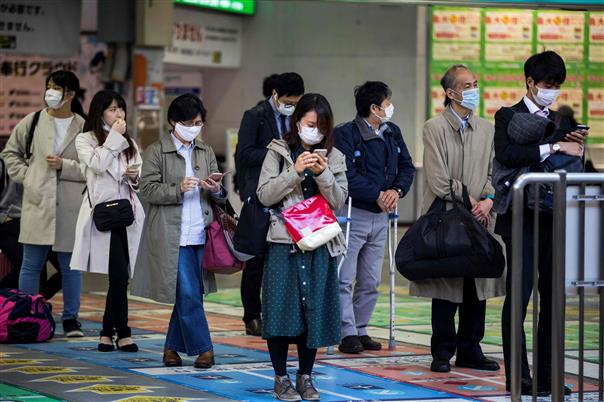
TOKYO : Tokyo was slowly getting into motion Tuesday with some people returning to their office and others heading to the park a day after Japan lifted a state of emergency over the novel coronavirus pandemic.
“There seems to be slightly more people,” said a male worker in his 30s who was among the people headed for their office in front of JR Tokyo Station.
“It’s not like we can immediately return to our previous lives. I pray that there won’t be a second wave (of infections) due to everyone letting their guard down,” he said.
A woman in her 40s, who had been commuting throughout the state of emergency period, which began April 7, said she is “happy that our daily lives are returning to normal,” but expressed worries that some people were not wearing a mask.
The metropolitan government has decided to ease its business suspension request in three steps, and the capital is now in the first stage.
Museums, libraries and indoor sports facilities are allowed to reopen, while restaurants, which had been asked to stop providing alcohol by 7 p.m. and close by 8 p.m., can now stay open and offer alcohol until 10 p.m.
An Odakyu department store in the capital’s busy Shinjuku shopping district reopened, with its workers wearing face masks and face guards.
“I had been waiting for the reopening. It’s fun to be at a department store after a while,” said 77-year-old Katsuyo Miura who traveled in from Sagamihara, Kanagawa Prefecture.
Playground equipment at municipal parks, which had been off limits, were also made available again.
Children dashed to the swings, jungle gyms and other equipment as soon as workers removed the safety tape from them at Kinuta Park in Setagaya Ward.
“I am really glad because I can now let my child play at a park without constraint,” said Megumi Tsukahara, 31, who lives nearby with her 2-year-old son Soma.
In Chiba Prefecture, where restrictions were similarly lifted, a theater was preparing to start welcoming visitors from Wednesday, with its staff sanitizing seats and ticket machines.
“I hope there won’t be a second wave (of infections),” said the theater’s manager Hiroshi Horikawa, 51.
Hokkaido Prefecture, one of the last five prefectures to have the state of emergency lifted, was also off to a slow start.
Hiroshi Momono, a 70-year-old worker for a nonprofit organization who was on a train to his office in Sapporo, said the number of people on the train had not changed from four days ago.
“Maybe the practice of getting on trains at different times is taking root,” he said.